Longyi: When Comfort Meets Tradition
Wrapped in tradition and deeply rooted in culture, Lyongi is Burma’s most iconic garment
by
Team Burma Burma
At dawn in Yangon, the light arrives through trees as tea shops open their shutters, and men twist the fabric at the waist, fingers folding the front of the longyi into a tight knot.
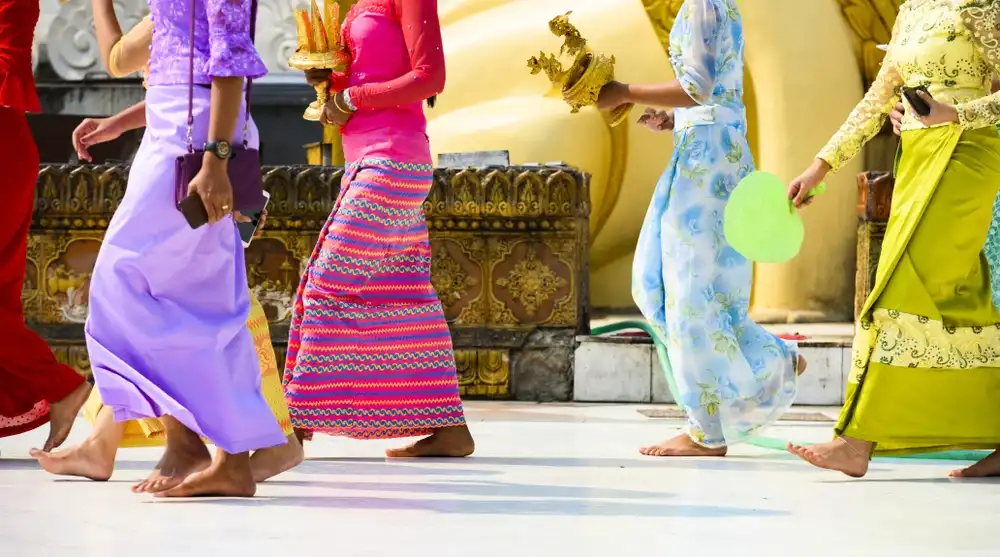
In Burma, Longyis are more than just a garment. Worn by men, women and kids, at weddings, parliaments and even in schools, Lyongi is a part of Burmese routine and culture. Lyongi is ingrained in the Burmese way of life to an extent that the material, colour and design can tell a lot about one’s lifestyle and status.
What is Longyi?
Longyi is a piece of cloth that can be wrapped around the waist and is widely worn across communities and regions in Burma. Roughly two metres long and around eighty centimetres wide, it doesn’t require tailoring to the legs or fastening the cloth. A Longyi can be simply wrapped around the waist by folding, knotting & tucking the cloth at one’s own convenience.
Types Of The Longyi
Before British colonial rule, Burmese men wore Paso, long pieces of unsewn fabric that could reach thirty feet, wrapped in bundles around the waist. Women wore another variant of Lyongi, Htamein, which was shorter, layered and often made with a silk or velvet border, revealing the calves and falling in folds.
With colonial influence came the stitched variant of longyi. Introduced for practicality and ease, it simplified dressing without erasing tradition. Stitched longyi replaced complicated wrapping rituals, yet people continued to use distinctive ways of folding and styling. Over time, the stitched longyi became standard across the country, bringing together colonial-era tailoring with traditional Burmese aesthetics.
One Longyi, Many Ways
The complexity of wrapping is how one differentiates between aristocracy and commoners. Expensive fabrics were made with imported silk, metallic thread and patterns, and people picked these depending on their class and economic status. Women’s htamein too evolved, structured as a rectangular cloth with a distinct upper waistband panel and decorative lower field. The ones made for court featured fine silk borders, while rural ones prioritised durability.
The quantity of textile, the richness of the dye and the intricacy of the weave communicated hierarchy within royal courts and regional communities. Textile production flourished in centres such as Amarapura, where specialised looms produced acheik wave patterns requiring coordinated weavers and precise shuttle work. Despite these structural shifts, traditional aesthetics were relevant. Traditional motifs, natural dyes, and gender-specific folding techniques remained relevant. By the twentieth century, the adoption of Lyongi cut across class lines and became a symbol of unity and Burmese daily life.
Now, in Burma, factory-produced cotton longyi coexists with handwoven silk, which is reserved for novitiation ceremonies, weddings, and religious festivals, maintaining a textile economy that blends mechanised production with artisanal craft.
Patterns That Speak
Regional identity in Burma is woven directly into cloth. Textile traditions vary depending on ethnic groups. Motifs, colour palettes and weaving techniques signifying the geography and lineage of that particular region and its people. Kachin textiles, for example, frequently use bold diamond motifs arranged in repeating grids. Bamar longyi often feature horizontal zig-zag bands or restrained geometric repeats in deep indigo, maroon, or forest green. Around Inle Lake, Shan weaving traditions favour softer floral motifs and lighter tonal contrasts, echoing the region’s delicate handicraft heritage.
These patterns are not just decorative; they carry symbolic meaning embedded in repetition. Amarapura, famous for its acheik silk, produces lyongis that are worn at weddings, rites, temple ceremonies and state occasions. The acheik longyi signals formality through craftsmanship and material. Once reserved for royalty and elites due to its labour and cost, it gradually entered wider public life in the twentieth century while retaining prestige. Alongside these ceremonial silks, everyday cotton longyi, handwoven in villages or factory-printed in cities, continued to be worn on an everyday basis, aided by the shift from natural to synthetic dyes
Why the Longyi Continues To Live On
Longyi is still widely used not just because of its cultural relevance but also because of its convenience. The simple structure eliminates seams between the legs, reducing friction in humid climates. Cotton varieties, most common in daily wear, absorb water or sweat and dry relatively quickly, making them suitable for tropical heat and sudden monsoon showers. Silk provides a natural warmth during cooler evenings in highland regions.
Longyi doesn’t come in one fixed size. It can be adjusted as required depending on your body shape, type and weather. The garment’s use extends to physical labour and public life. Farmers in delta regions hitch the hem upward when wading through flooded paddies; construction workers knot the front securely to climb scaffolding; cyclists and street vendors adjust folds instinctively to maintain balance and mobility. In religious spaces, the longyi supports norms of modesty.
A Symbol of Culture
In modern Burma, where Western-style trousers and skirts are increasingly visible in corporate sectors and among youth, the longyi coexists. It is worn in parliament sessions, university classrooms, monasteries and markets alike. Unlike in many neighbouring countries, where traditional attire is reserved for festivals, Burma’s longyi is celebrated every day.
FAQs:
1. What is a Longyi, and how is it different from the Lungi?
Both Lyongi and Lungi are essentially the same concept. A longyi is a traditional cloth from Myanmar that people wrap around their waist. Both men and women wear longyi, but the style is a little different. Men wear a longyi called a paso, tied with a simple knot, while women wear a htamein, which is more decorative. Longyi comes in many colours and patterns and can be worn every day or for special occasions. A longyi is different from a lungi, which is worn mostly by men in India, Bangladesh, and Sri Lanka and is usually casual wear at home. Lungi fabrics are simple and mostly for comfort, while longyi is part of Burmese culture and can be worn anywhere, from work to festivals.
2. How to wear a longyi?
In Burma, the longyi is more than clothing. It is everyday ease. To wear a longyi in Burma, the style differs slightly for men and women, but the comfort remains the same.
For men in Burma, the longyi is worn in the paso style. Step into the longyi tube and hold the top edge on both sides. Pull the fabric firmly across the front, then twist the excess cloth at the centre into a secure knot and tuck it inward. The longyi in Burma sits high and neat, practical for daily life.
For women in Burma, the longyi, known as the htamein, is stepped into and aligned with the seam at the back. The front panel of the longyi is folded flat across the waist and tucked securely at the side for a smooth, straight fall, often wrapped from right to left. In Burma, the longyi is tied each morning with familiarity, simplicity, functionality, and is deeply rooted in Burmese identity.
3. Where to buy good-quality longyi?
Longyis are widely available across Burma, from bustling local markets such as Bogyoke Aung San Market (formerly Scott Market) to specialised silk shops in Mandalay. Prices are generally affordable, starting at around 5,000 kyat for everyday cotton styles, with higher rates for handwoven silk pieces.
4. Can foreigners wear a longyi?
Yes, foreigners can wear a longyi. While the longyi is a cultural symbol in Burma, there aren’t strict rules about who can wear it. Visitors often choose to wear a longyi when visiting temples, cultural sites, or festivals, because it’s practical and comfortable in the climate and helps them blend in respectfully with local customs.
5. What to wear with a longyi?
Men: A collared shirt, T-shirt, or traditional Burmese jacket (taikpon) pairs well with a paso.
Women: Blouses, fitted tops, or traditional fitted jackets complement a htamein.
For formal occasions, silk longyi are paired with crisp, tailored tops.
Footwear is usually sandals or simple flats in daily settings.