Shwe Zawa: A Technique That Makes Burmese Art Glow
A story of gold and why Burma Burma adds a shimmer of Burmese art at every address
by
Team Burma Burma
You’ve likely experienced the beauty of Shwe Zawa. The phrase translates to “gold leaf painting,” but the effect is more alchemy than label.
In a dimly lit temple hall in Burma, centuries ago, an artisan crouched before a wall of freshly laid lacquer, a bowl of gold leaves on his side. He wasn’t just painting a scene; he was telling a story of gods, kings and the Buddha’s compassion. But what he didn’t know was that this story would shimmer by candlelight long after he was gone. That’s the magic of Shwe Zawa, the Burmese art of painting with gold.
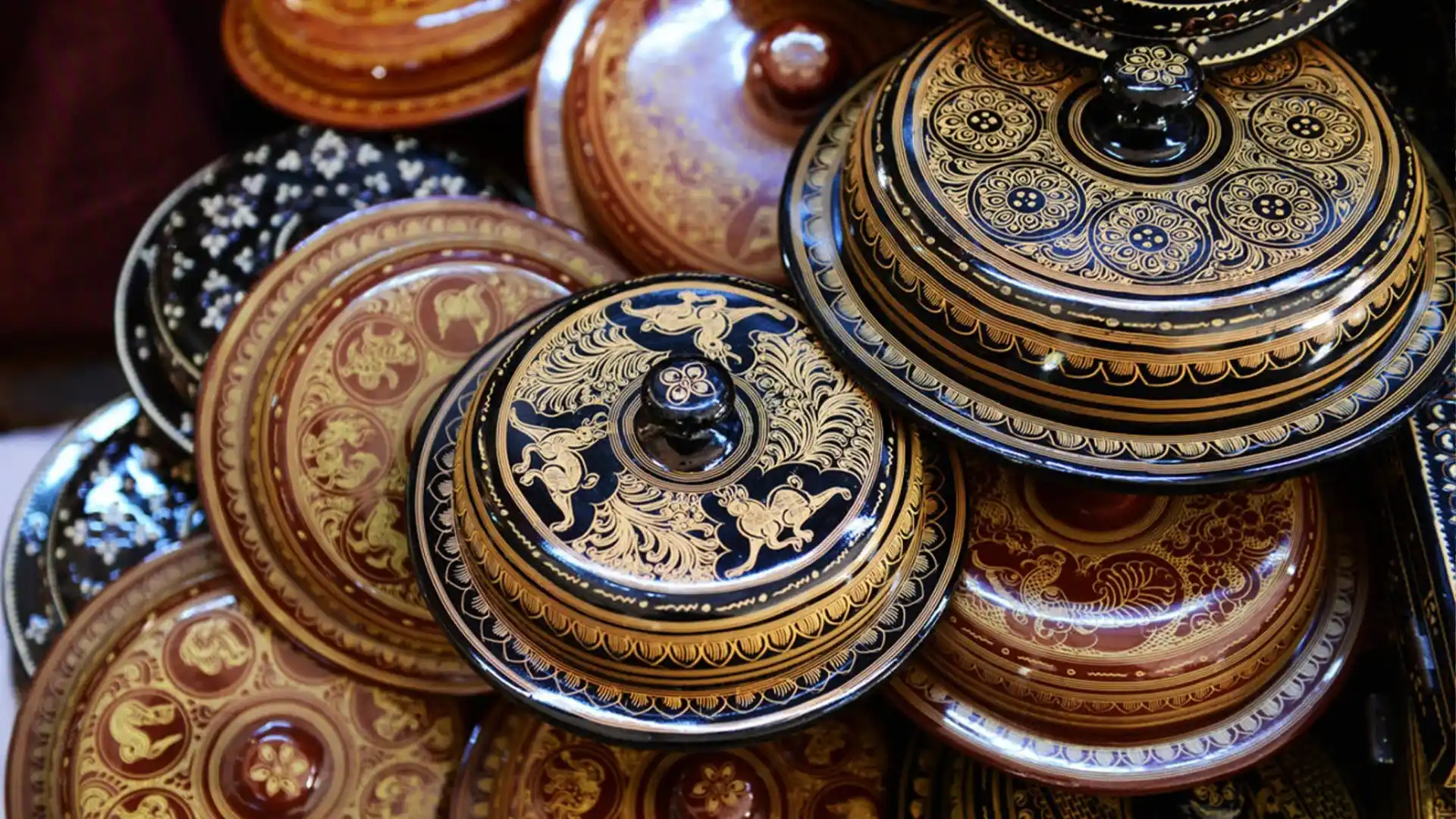
Today, its traces gleam faintly in monasteries and royal relics. But you’ll see hints of it in brass pendants, and mainly black lacquerware utensils and boxes on which intricate patterns and designs are painted in gold. Its principle remains the same: let light tell the story.
The golden age of gold
The art of Shwe Zawa bloomed during the royal eras of Burma from the late 1600s through the 19th century, when kings ruled from Ava, Amarapura, and Mandalay.
This was a time when artisans were both storytellers and engineers of light, when the temples were their canvases and the walls their manuscripts.
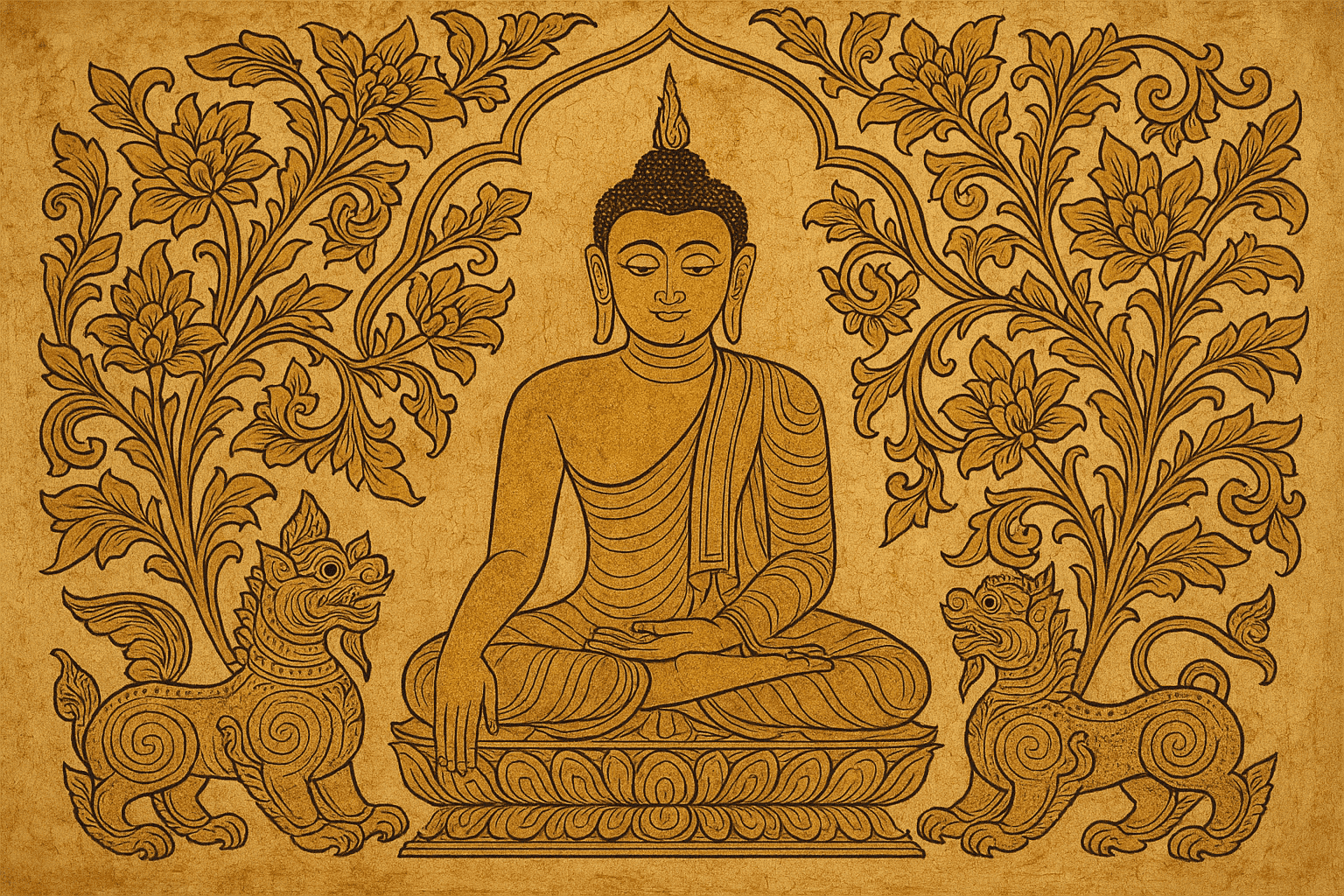
The art of Shwe Zawa was meant to dazzle and illuminate the path to enlightenment. Gold stood for purity, merit, and compassion. To gild a Buddha’s halo was to make visible the radiance of awakening. To gild a pagoda spire was to send merit skyward.
Every stroke of gold was both devotion and design; a way of transforming the material into the sacred. Under flickering oil lamps, these paintings would come alive: faces glowing softly, lotus petals gleaming, halos pulsing with warmth. Gold was a language of light.
How to paint with gold
To make Shwe Zawa, artisans first needed the gold itself. In Mandalay’s gold-beating quarters, workers still hammer thumb-sized nuggets into impossibly thin sheets. Each leaf is beaten between sheets of bamboo paper until it is wafer-thin. These are then sold in small square books for temples, manuscripts, lacquerware, and, in the old days, for murals.
The technique is part science, part meditation. A dark lacquer or pigment base is prepared first; gold leaf is laid over it, pressed gently, then brushed and etched to reveal detail. Sometimes artisans would incise patterns into the gold or layer it with red and black lacquer for depth. The result: an image that shifts and breathes with the light.
In temple murals, only certain areas were gilded — halos, ornaments, borders — so that gold could play off matte colour and shadow. The art was about balance, not blinding brilliance.
More than just glitter
Gold in Burmese art held many meanings at once. It was royal, yes. A mark of wealth and generosity, but it was also spiritual. To reflect light in this manner meant to mirror wisdom. In Buddhist belief, the Buddha’s body itself was said to shine like burnished gold; Shwe Zawa merely tried to catch that glint.
The choice of black lacquer as a base wasn’t a coincidence either. In Burmese aesthetics, darkness is what allows the divine to appear. The contrast — of black void and golden form — was a visual metaphor for the journey from ignorance to enlightenment.
So when you stand before a Shwe Zawa panel, what you see is philosophy that’s gilded in.
Shwe Zawa under colonial rule
Like many royal arts, Shwe Zawa’s fortunes dimmed under colonial rule. With the fall of the Burmese monarchy in 1885, royal ateliers dissolved. The British brought new materials, new aesthetics, and a modern art market less interested in devotional glow than in realism and portraits.
Gold leaf remained in use for religious offerings — pilgrims still press it onto Buddha statues at pagodas across Myanmar — but the great narrative murals faded from the walls. In lacquer towns like Bagan and Bago, smaller Shwe Zawa pieces survived as keepsakes, tourist curios, and manuscript covers. The craft persisted, even as its grandeur retreated.
The revival: Gold returns to the canvas
Today, Shwe Zawa is experiencing a revival. Contemporary Burmese artists, many trained in Mandalay or Yangon, are rediscovering the language of gold as metaphor. Some layer gold leaf over abstract fields to suggest light breaking through history. Others adapt it into lacquer panels, merging folklore with modern minimalism.
Meanwhile, Mandalay’s goldbeaters still keep time with their hammers, ensuring the tradition of over 1,000 years continues. And across galleries in Southeast Asia, you’ll now find Shwe Zawa-inspired works gleaming unapologetically.
Shwe Zawa at Burma Burma
You’ll find the same philosophy alive at Burma Burma Restaurant & Tea Room. Our design language borrows from the restraint of Shwe Zawa, the metallic finishes that accentuate the corners, warm brass tones that catch the eye, and lacquered details that echo Burmese craft traditions.
Much like a mural with Shwe Zawa, each space glows softly, inviting you to linger.
That’s the enduring wisdom of Shwe Zawa: use light sparingly but make it count. Shwe Zawa isn’t just a lost craft; it’s a lens on how the Burmese see the world. In a world of overexposure, this golden art teaches us to notice how beauty often begins in shadow.