The Stories Behind Burmese Art
A Complete Guide to Burma’s Artistic Heritage
by
Team Burma Burma
If you walk into a temple in Burma, look closely at the walls, open an old lacquer box, look at the gold on a Buddha image or pick up a hand-painted manuscript. The more closely you look, the more you realise that art in Burma has never really been separate from everyday life. It lives in temples and monasteries, royal courts and tea shops, on objects used for offerings and in utensils used at home. It appears in intricate lacquerware, painted stories, carved wood, gilded sculptures and murals that have survived for centuries.
Burmese art is, in many ways, a record of the country itself: its Buddhist traditions, royal history, craftsmanship, folklore and everyday life. And while its roots go back centuries, it isn't an art form frozen in the past. Traditional techniques and visual languages continue to influence artists and craftspeople today. So, what exactly makes Burmese art distinctive and how did these traditions come together?
Let's take a closer look.
What Is Burmese Art?
Burmese art refers to the many artistic and craft traditions that developed across Burma over centuries, from Burmese painting and Buddhist sculpture to lacquerware, wood carving, gold leaf work and manuscript art. There isn't one single Burmese art style as the country's artistic heritage has been shaped by different kingdoms, communities, religious traditions and centuries of interaction with neighbouring cultures.
Buddhism has had one of the strongest influences on Burmese art. Stories from the life of the Buddha, Jataka tales, sacred symbols and religious figures appear throughout Burmese artwork. But alongside these are scenes of royal and village life, folklore, animals, nature and ordinary people going about their day. Perhaps that is what makes Burmese art so interesting. It isn't just something made to be looked at. Historically, it has also been something to use, worship, preserve, pass down and live with.
A Journey Through the History of Burmese Art
To understand Burmese traditional art, it helps to go back to the places where some of its earliest surviving forms flourished.
Bagan: Where Art, Architecture and Faith Came Together
Few places are as important to the history of Burmese art as Bagan. Between the 11th and 13th centuries, Bagan grew into a major Buddhist centre, with thousands of temples, pagodas and religious monuments spread across its landscape. These weren't just architectural structures; their interiors became canvases. Walls were covered with paintings depicting stories from the life of the Buddha, Jataka tales, celestial beings, animals and scenes from the world around them. Sculptors created Buddha images and decorative figures, while artisans worked in stucco, wood, lacquer and gold. The result was a visual world where architecture, painting, sculpture and storytelling existed together.
Many of the surviving murals are particularly valuable because they offer glimpses into the religious beliefs and daily Burmese life, such as how people dressed, travelled, lived and imagined their world centuries ago. The influence of Indian Buddhist traditions, particularly those associated with eastern India, can also be seen in the art of this period. But Burmese artists adapted these influences into their own forms, proportions and visual language. Bagan's artistic legacy continued to influence Burmese art long after the kingdom itself declined.
Burmese Painting: Stories Told in Colour
Painting has always been one of the most expressive forms of Burmese art. Historically, a Burmese painting wasn't necessarily something you'd find hanging inside a frame. Artists painted on temple walls, manuscripts, folding books, cloth and even glass. The subjects changed depending on where the painting was being made, but storytelling remained a recurring thread.
Temple murals
The murals of Bagan are perhaps the best-known examples. Inside temples, paintings were used to tell Buddhist stories visually. For visitors who might not have been able to read, these images offered another way of encountering religious teachings. The murals weren't limited to solemn religious scenes. Look closely and you can find animals, musicians, architecture, clothing and glimpses of everyday life woven into the larger narratives. The temples themselves became a kind of storybook.
Parabaik: Painting on a Folding Book
Another distinctive tradition is the parabaik, a type of folding manuscript traditionally made from paper. These books could contain writing, illustrations and paintings, with artists depicting everything from Buddhist narratives to court ceremonies and everyday scenes. Some surviving examples from the royal courts provide fascinating visual records of Burmese life. They show processions, entertainments, ceremonies and people in elaborate dress, giving us a glimpse into a world that written histories cannot always capture in the same way.
Painting on Glass
One of the more unusual forms of Burmese painting is reverse glass painting. As the name suggests, the artist paints on the back of a sheet of glass rather than the front. This changes everything. The composition has to be planned in reverse because the details that would normally come last need to be painted first. A small mistake can mean that an entire section needs to be reconsidered. This technique became particularly popular in Burma during the 19th century and was used for religious images, portraits and other subjects. The result is often incredibly luminous. Colours appear to sit beneath the glass, giving the finished artwork a distinctive depth and shine.
Burmese Buddhist Art: More Than Images of the Buddha
It is difficult to talk about Burmese art without talking about Buddhism. For centuries, Buddhist beliefs have influenced not just what artists depicted, but also why the artwork was made in the first place. Buddhist art in Burma includes paintings, sculptures, manuscripts, temple decoration and ceremonial objects. It can tell stories, inspire devotion, mark a sacred space or simply serve as an offering. And within all of this, the Buddha image remains one of the most recognisable forms.
Buddha images have been created in Burma using wood, bronze, stone, stucco and other materials. But what makes many Burmese sculptures especially striking is that the material you see isn't necessarily the material the artist started with. A wooden sculpture might be covered with lacquer. A lacquered surface might then be gilded. Gold leaf might be added to bring out specific details. Paint might be used to bring other elements to life. In other words, a sculpture could become the meeting point of several different Burmese crafts. The Buddha's posture, hand gestures, facial expression and surrounding details also carry meaning. A raised hand, a particular seated position or the presence of a halo can communicate different aspects of Buddhist thought and imagery. Gold, meanwhile, has long held an important place in Burmese Buddhist art. Its luminosity makes it especially suited to sacred objects, while the act of gilding itself has traditionally been connected with acts of devotion and offering.
Burmese Lacquerware: Art You Can Hold
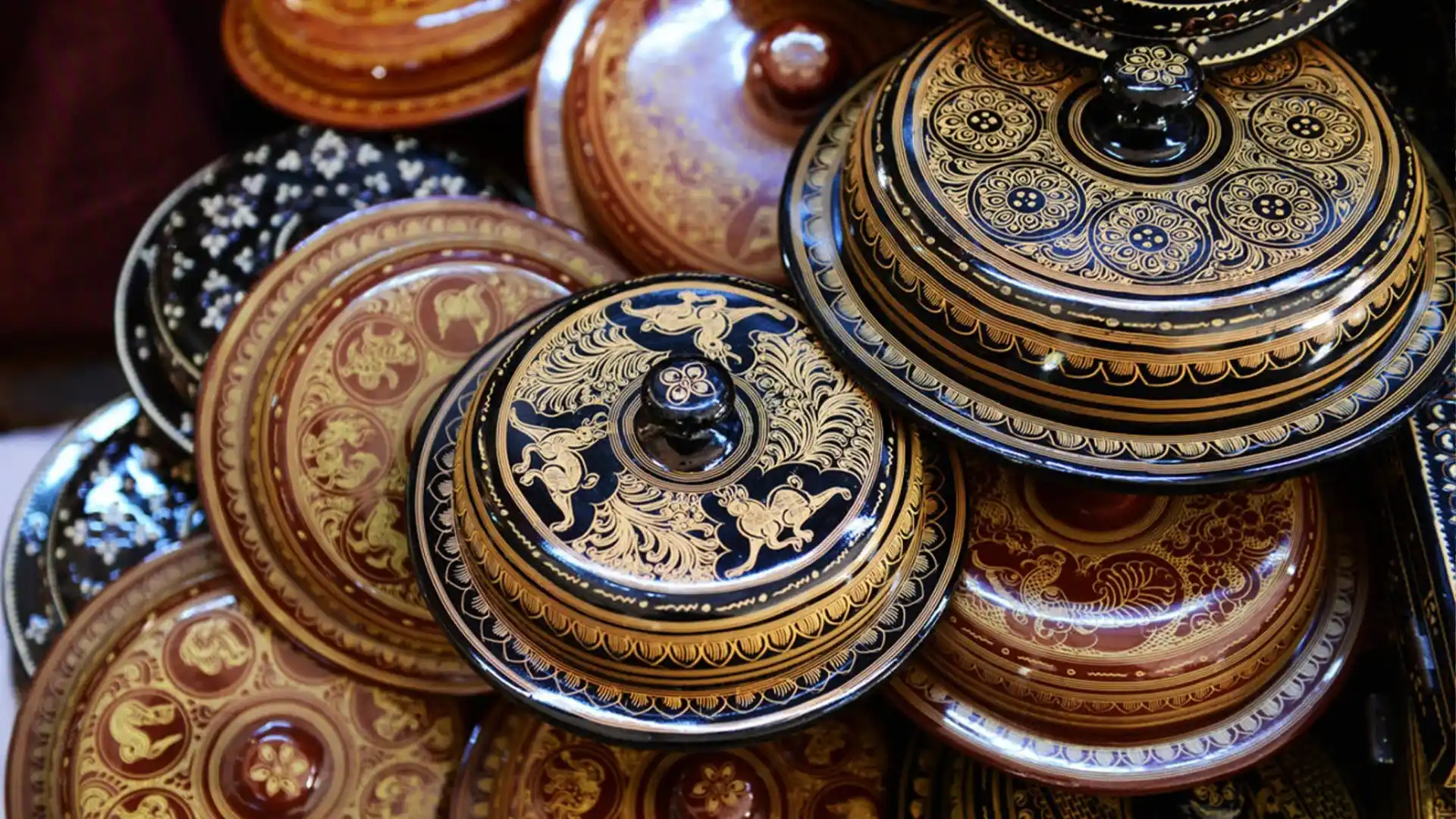
If there is one Burmese art form that perfectly captures the relationship between beauty and everyday life, it may be Burmese lacquerware. Walk through a traditional market in Burma and you may find lacquered bowls, trays, boxes, containers and offering vessels. Some are simple and understated. Others are covered in intricate patterns, figures and stories. And behind these seemingly delicate objects is a remarkably demanding craft.
How Is Burmese Lacquerware Made?
Traditional lacquerware often begins with a lightweight framework made from materials such as bamboo. Layers of lacquer are applied to the surface, with each layer requiring time to dry and harden before the next stage begins. Depending on the object and technique, the surface may then be engraved, painted, gilded or decorated with raised patterns. This process can take weeks or even months. One particularly distinctive technique is thayo, where a mixture is used to create raised decorative designs on the surface before it is finished with lacquer and colour. Other pieces use fine incised lines to create elaborate drawings directly into the surface. The imagery can include flowers, animals, mythical creatures, Buddhist stories and geometric patterns. While lacquerware was made for religious or ceremonial purposes, much of it was also made to be used. That is an important part of understanding Burmese craftsmanship: something can be functional and deeply artistic at the same time.
Burmese Sculptures: From Temple Figures to Intricate Wood Carving
Sculpture in Burma takes many forms. There are the familiar Buddha images along with guardian figures, mythical creatures, architectural carvings and decorative sculptures. Wood plays an especially important role. Burmese wood carving can be extraordinarily detailed. Teak and other woods have traditionally been carved into religious figures, furniture, architectural elements and decorative panels. Floral motifs, animals and mythical figures can emerge from a single piece of wood with astonishing intricacy. And again, carving often isn't the final stage. A carved object might be painted, lacquered or gilded, creating an artwork that combines several traditional techniques.
This layering is something you'll notice throughout Burmese art. A single object can tell the story of several craftspeople working together: the person who shaped the wood, who applied the lacquer, who painted the surface and the artisan who added the gold.
The Golden Touch: Gold Leaf in Burmese Art
Gold is everywhere in the visual language of Burma. It catches the light on pagodas, covers Buddha images and appears on lacquerware, manuscripts and religious objects. One traditional technique associated with this is Shwe Zawa, a form of gold-leaf painting. Instead of simply covering an entire object in gold, artisans use gold to draw and decorate the surface. Fine lines, figures and patterns emerge against darker backgrounds, creating a dramatic contrast. The technique requires patience and a remarkably steady hand.
There is something particularly beautiful about the way gold behaves in Burmese art. In bright daylight, it can appear almost dazzling. In the softer light of a temple or room, individual details begin to emerge slowly. The gold isn't just decoration here, it changes with the light.
What Stories Does Burmese Art Tell?
Look across different forms of Burmese artwork and certain subjects appear again and again.
Buddhist stories
Scenes from the Buddha's life and Jataka stories have been among the most important subjects in Burmese painting and sculpture.
Royal life
Court artists documented ceremonies, processions, royal entertainments and courtly life, particularly during the later kingdoms.
Nature and animals
Animals appear throughout Burmese art, sometimes as decorative elements and sometimes as important characters in religious stories and folklore.
Mythical beings
Figures from Buddhist and Burmese cosmology, including celestial beings and mythical creatures, appear in murals, sculpture, manuscripts and architectural decoration.
Everyday life
Some of the most fascinating paintings are those that show ordinary activities: people travelling, eating, working, performing music or participating in ceremonies.
Together, these subjects make Burmese art more than a collection of beautiful objects. They create a visual record of how people understood their world.
The Many Influences Behind Burmese Art
Burmese art has always been connected to the wider region. Burma sits at an interesting crossroads between South Asia and Southeast Asia and centuries of trade, travel and cultural exchange brought new ideas, materials and artistic techniques.
Indian influences
Indian Buddhist art had a particularly strong influence on early Burmese Buddhist art. Ideas travelled through religious networks, and artists adapted visual traditions from eastern India into their own work.
Southeast Asian connections
Artistic exchange also took place with neighbouring cultures across Southeast Asia. Similar religious traditions, materials and decorative ideas travelled between regions and were adapted locally.
Western influence
By the 19th century, Western painting techniques were becoming increasingly visible in Burmese art. Artists began experimenting with perspective, shading and more naturalistic portraiture. The Burmese artists proposed that traditional subjects could be approached using new techniques. That conversation between the old and the new is something that continues to define Burmese art.
Traditional and Contemporary Burmese Art
It can be tempting to think of Burmese art as something belonging entirely to the past. But the tradition is still evolving. Contemporary Burmese artists work across painting, sculpture, photography, installation and mixed media. Some draw directly from Buddhist imagery, folklore and traditional motifs. Others explore completely modern subjects and forms. What connects these different generations isn't necessarily a particular style but the idea of taking what came before and finding a way to make it relevant to the present.
Even traditional crafts continue to inspire contemporary design. Lacquer techniques, gold leaf, wood carving and traditional patterns can be reinterpreted in new ways without losing their connection to their origins. This is also why it is useful to think of "traditional" and "contemporary" Burmese art not as two separate worlds, but as parts of one ongoing story.
How to Appreciate Burmese Artwork
You don't need to be an art historian to look at Burmese art. In fact, sometimes the best way to begin is simply to slow down. Look at the surface. What is it made from? Is it wood, lacquer, bronze, paper, glass or stone? Then look at the details. How was it made? Can you see engraving? Layers of lacquer? Gold leaf? Carved patterns? Brushwork? Then look at the story. What is happening in the artwork? Is it religious? Ceremonial? Historical? Everyday? And finally, think about the object itself. What was it made for? Was it meant to be worshipped, used, gifted, displayed or carried? That last question can completely change how you see a piece of Burmese artwork.
A lacquer bowl isn't simply a beautiful bowl. A manuscript isn't simply a decorated book. A Buddha image isn't simply a sculpture. Each one can carry a history of craftsmanship, belief and everyday life.
Collecting and Preserving Burmese Art
Burmese artwork can be found in museums, private collections, religious spaces and homes around the world. If you're collecting or caring for an older piece, understanding its history is as important as appreciating its appearance. Provenance matters. Knowing where an object came from, how old it is and how it has travelled can help establish its cultural and historical context. Materials matter too. Paper, wood, lacquer, textiles and painted surfaces can all be affected by humidity, temperature, sunlight and handling.
Lacquerware, for instance, should ideally be protected from prolonged direct sunlight and large changes in environmental conditions. Fragile painted or gilded surfaces also benefit from minimal handling. And when it comes to religious artwork, there is another layer to consider: cultural respect. A Buddha image or religious manuscript may have a significance far beyond its artistic value. Understanding that context is part of preserving the object responsibly.
Why Burmese Art Still Matters
Perhaps the most beautiful thing about Burmese art is that it has never really been about art alone. It is about stories, faith and craftsmanship. It is about the hands that made something and the generations that carried it forward.
A temple mural can tell us how people imagined the world hundreds of years ago. A lacquer box can show us the patience and precision of a craft passed down through generations. A gilded Buddha can tell us something about devotion. A painting of a royal procession can preserve a moment of history.
And sometimes, the most interesting artwork is not something locked away behind glass at all. Instead, it is something that was made to be held, used, offered, carried or lived with. That is what makes Burmese art so compelling. It doesn't draw a hard line between art and life but lets them exist together. And perhaps that is the best way to understand Burma's artistic heritage: not as a collection of objects from another time, but as a living tradition that continues to tell stories, carry memories and find new forms.
Frequently Asked Questions
What is Burmese art known for?
Burmese art is particularly known for Buddhist sculpture, temple murals, intricate lacquerware, wood carving, gold leaf work and narrative painting. Many of these traditions combine artistic beauty with religious, historical or everyday significance.
What are the main types of Burmese traditional art?
Some of the best-known forms include Burmese painting, Buddhist art, lacquerware, sculpture, wood carving, gold leaf work, manuscript art and temple decoration.
What materials are traditionally used in Burmese art?
Burmese artists and craftspeople have traditionally worked with wood, bamboo, lacquer, paper, bronze, stone, stucco, glass and gold leaf, among other materials.
Why is Buddhism important to Burmese art?
Buddhism has shaped Burmese art for centuries. Buddhist stories, symbols and figures appear throughout painting, sculpture, architecture, manuscripts and decorative arts, while temples and monasteries have historically been major centres of artistic production.
What is Burmese lacquerware?
Burmese lacquerware is a traditional craft involving layers of lacquer applied to objects such as bowls, boxes, trays and vessels. Artisans may then engrave, paint, gild or add raised decorative patterns to the surface.
What is Shwe Zawa?
Shwe Zawa is a traditional Burmese technique involving gold leaf applied to create decorative designs and imagery. The gold is often set against darker surfaces, creating the luminous contrast associated with the technique.
Is Burmese art still made today?
Yes. Traditional crafts such as lacquerware, wood carving and gold work continue alongside contemporary painting, sculpture and other forms of artistic expression. Contemporary artists also reinterpret traditional Burmese subjects, techniques and imagery in new ways.